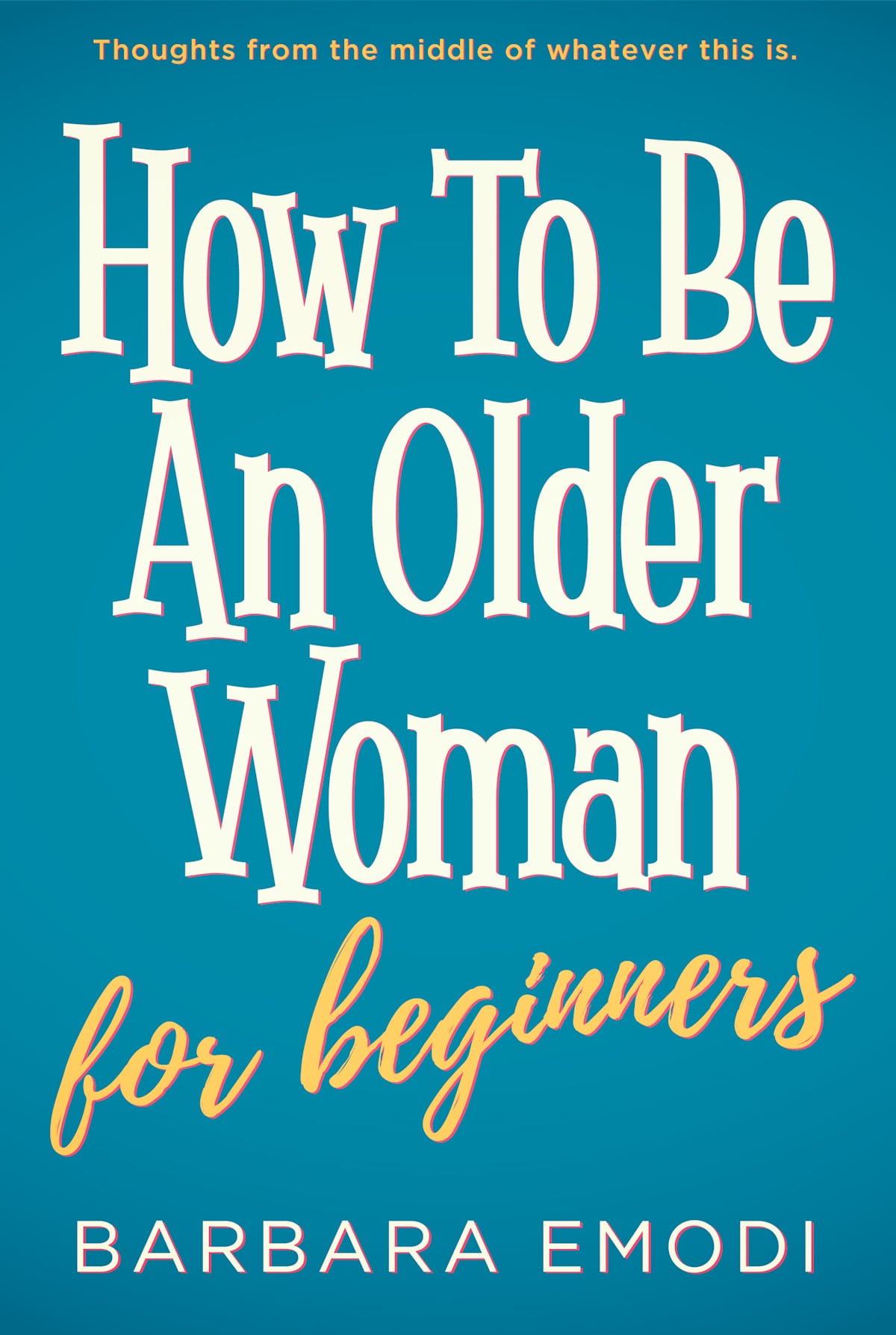
For anyone who ever went looking for the So You Want to Be an Older Woman manual and came up empty: here it is, more or less. How to Be an Older Woman for Beginners is a collection of essays about getting older, drawn from my Substack of the same name. Written on dog walks and posted from a kitchen table in Nova Scotia, these are dispatches from the far bookend of life, the one nobody hands you instructions for, delivered with humour and a strong suspicion that karma is, in fact, a thing. Here are the Introduction and the first essay to get you started.
INTRODUCTION
Growing up in the sixties in a small town on the Canadian prairies, I spent considerable time at the local library, a decommissioned bank building on the main street. There I looked for guidance on how to live in a world beyond my own immediate experience. I read British books about children who went to the seaside (I didn't see the ocean until I was eighteen), built tree houses (all I knew were pliable, windbreak poplars), and made bonfires (something only the local farmers did when it was time to burn off the fields).
Those Enid Blyton-era books, housed in the children's department in the old bank's basement, next to the giant safe, always made me feel inadequate. But a sympathetic librarian noticed me, and no doubt feeling the claustrophobia of her own underground workplace, gave me special permission to go upstairs and borrow adult books.
It was there on the main floor of grown-up publications, under the vaulted ceiling and among the Corinthian columns of the building's pre-retirement life, that I discovered the mesmerising 600s (Applied Science) and the 700s (Arts and Recreation) of the Dewey Decimal system. In those rows of books, I found exactly what my ten-year-old soul sought: manuals for life outside the dusty city limits defined by the last street, where my family lived.
The best books, the ones I hungered for, all had titles that started the same way: So You Want to Be a Bee-Keeper, So You Want to Build Your Own Seaworthy Boat, So You Want to Spin the Wool of the Black-Faced Sheep.
I didn't know what my future would hold, but I knew I wanted to be ready for it, so I read. In 1962, I already suspected life would require more from me than my Brownie Darning Badge.
The years that followed didn't require many of those library-learned skills, but the you-can-figure-it-out, how-hard-can-it-be? attitude they expressed stayed with me and defined who I became. Usually, this approach has been all I needed, that is, until I approached the other bookend of existence. The mature, post-retirement, senior years.
Where were the So You Want to Be an Older Woman books when I needed them?
Nowhere I could find.
Instead, I picked up manuals for responding to tough times by climbing mountains or rowing across the Atlantic. How-tos on how not to lose muscle mass or mental marbles. Manifestos of spunk (written, I suspected, by women in bright glasses and turquoise lace-up boots), that were both exhausting or exhausted; I wasn't sure which. Like most women, I had spent my life meeting impossible standards. Measuring up and making the best of it. Delivering, compensating as a matter of course, serving myself last at every buffet.
What I didn't need now was a postscript disguised as yet another job description.
But what did the alternative look like? For someone like me? A person making it up as she went along, fortifying herself only with humour and a strong suspicion that, yes, karma was a thing?
Where were the instructions for that life?
I decided that the book I wanted to read was going to be one I wrote myself. And I did that in a Substack column called, How to Be an Older Woman for Beginners. A selection of those essays is collected here.
In many ways, this book is a shared journal, a record of thoughts about this stage of life, mulled over on a dog walk, written and posted when I get home.
This project was nurtured by reader reactions expressed in both posted comments and personal emails. This ongoing connection has reassured me that, whatever this stage of my journey brings, I am not travelling the road alone.
There is nothing ordinary about ordinary women. I'm one myself. I know.
My readers have brought me here. I hope some of these words land somewhere useful or at least make us both smile. After all, these decades call on us to be both wise and brave, but they never ask that we do it alone, or without humour. Let's chat about that.
THE DEMOTION
(from Part One: Job Reassignment)
I am in the hallway. This is the only place where there is room for the table. I am alone with five hundred envelopes and five hundred fundraising letters.
In another part of this building, some of the kids I taught are at work. One is the director of communications.
I retired. Time to volunteer, I thought. There is an annual telethon. I could help. I know the producers. I know the anchors. I have worked with the reporters.
The woman who brought me to the hall appears.
“You know the lady who usually does this has a system. Two piles,” she says. “She'll be back next week.”
I won't be.
Later on my morning walk, I pass a woman from the neighbourhood. I don't know her well, but I recognize her from events at the school when my children were little.
“Do you want someone to walk with you?” she asks. She used to organise mile-long street sales year after year. Then they stopped. I wondered if she had moved. “My husband doesn't walk.”
“How are you these days?” I ask.
“You know, getting older.” She is my age. “Let me give you my phone number.” She reaches for a pencil and paper in her pocket. She writes down half of her phone number and looks up at me. “What's the rest of it? I don't phone myself.”
When I go home, I put her phone number under a magnet on the fridge.
I wasn't expecting this. Every other stage of my life, I figured it out. That's what I will try to do now.
How to Be an Older Woman for Beginners is available as an ebook, exclusively on Amazon and free to read in Kindle Unlimited, and in paperback wherever books are sold. Find it on Amazon here: [ADD AMAZON LINK]
August 23, 2026
Read the Introduction and First Essay from HOW TO BE AN OLDER WOMAN FOR BEGINNERS