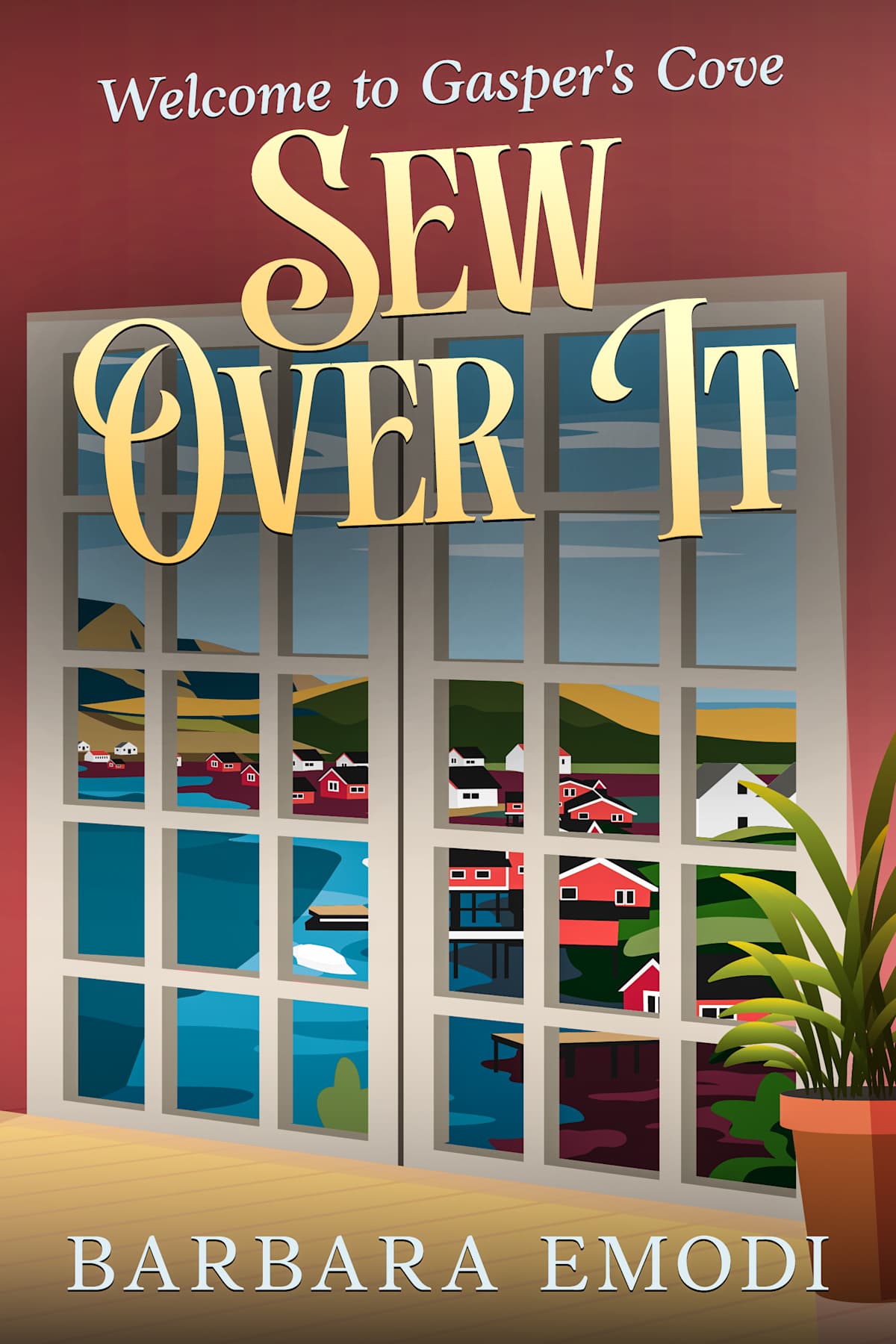
Welcome to Gasper's Cove, a small town on the coast of Nova Scotia that doesn't quite exist but will feel awfully familiar to anyone who lives somewhere like it. In this first Gasper's Cove cozy mystery, sewing teacher Valerie Rankin just wants her fledgling sewing school to get off the ground. Then a sewing machine salesman turns up dead in the store parking lot, and Valerie and her Seaside Sewists put down their seam rippers and start detecting. Here are the opening pages to get you started.
Prologue
Who would have thought it would be this easy?
And so fast too.
There she was. Head down, fifty feet from the turnoff to her own house. The driver caught a glimpse of her from the bend and knew immediately who it was.
Hard to believe the luck of it. The one last loose end, walking along the Shore Road. Not paying any attention at all, trusting her feet to take her home.
She didn't hear the car.
To the right, a drop of two hundred feet down to the North Atlantic, the sea close, the ice from the cliffs like fingers reaching for the water. Only a bureaucrat would think a two-foot-high guardrail would save anyone from the rocks and cold surf below. An accident waiting to happen. There was a reason the two of them were alone on this road tonight. It had to be done.
The driver dimmed the lights. Just like always, for the sake of oncoming traffic. Then reached out again and clicked them off.
The road went dark.
The woman was across from the house when the lights flared back on. Her face, white and surprised, turned to look back. Then she did what anyone would, she moved away. As fast as she could, tripping, off balance. Too late to stop herself from arching over the rail, from skidding down over the crust of the snow, through the bushes to the edge. The black night took her.
Too easy.
Chapter One
We were on the way into town along the Shore Road, when a horn blasted through the car like a siren and cut through our conversation. My seatbelt tightened against my shoulders as I looked into the rear-view mirror. Behind us, far too close, were the huge headlights and grille of a Nova Scotia Department of Transportation salt truck. In it, I saw the grim face of a driver struggling to control the massive vehicle on the ice. The truck swerved, bumped into the snowbank on the hillside to the left, then careened back over in front of us. A curtain of snow and salt hit the windshield and a slew of slush slapped up against the door. I gripped the steering wheel and held on as the road in front of me vanished. Then the wipers made a pass, and then another, carving fans through the ice and snow on the windshield. A small window appeared, and I lowered my head, peered through it, and found the road again. Ahead, the truck's red taillights barrelled away out of sight, horn still blaring.
Beside me, my cousin Darlene let out a breath. "That was close, Valerie Rankin. You can't drive like this on a highway, my dear. Too slow is as dangerous as too fast."
"It's this stretch of road," I tried to explain. I knew I'd drifted over the white line to move away from the sheer drop of the cliff beside us. I hated heights. I lived in a bungalow. I didn't wear high heels. And I didn't like to drive this road, not this time of year. "I was just trying to be careful."
Darlene reached over and patted my shoulder with her mittened hand. "My girl, you got to relax. This isn't worth getting us nearly run over for. It'll be fine. What's to worry? How hard can it be?"
How hard can it be?
That was Darlene's life motto; it sure wasn't mine. This morning was only a couple of tables of sewing projects on display in an old general store, but to me, it was a very big deal. This was the first time I'd organized something public like this. I didn't know what I was doing. Darlene didn't know what worry was. Most of the time, life didn't have the heart to let her down. My cousin could enjoy herself, even in the middle of events that would knock most of us back. For instance, when her third husband left her, Darlene announced at least now she could get a cat. She liked cats. Knowing a Darlene steadied a person.
"You've done harder things, Valerie Rankin," my cousin continued. "Brought kids up on your own, moved back home to the island. This is sewing. What you do best. Look at this beautiful top you did for me."
I looked sideways at Darlene's crossover V-neck; I'd made it as a sample when I taught "Knits without Fear." The press-on stars on her nails matched its colour and I detected a shimmer of gold dust along her cleavage. My cousin was a great supporter of special events and had helped me organize this one.
"Tell me again what everyone is going to do," I asked, fishing for reassurance. I had invited a travelling sewing machine Rep. for the morning. I needed a discount on some classroom equipment.
"We've got our best stuff to show today, don't worry." Darlene was a believer. "Our creativity will blow that man from Montréal away."
"Let's hope so."
"Here's what's going on," Darlene counted off our participants on her glittering fingers. "Katie and Sarah are bringing their reversible tote bags. Husbands' turns to take care of the kids."
My newest students, Katie and Sarah, moved around town like a unit, on the lookout for escape hatch activities to break up the days spent with five small children between them. So far, they had tried yoga, hot and cold, the Walk the Weight Away club, and selling pyramid scheme jewellery. But they liked my classes best, and described themselves as sewists, which they said sounded more modern than sewers, which might be confused with plumbing.
Darlene continued her list. "Agnes is bringing her wine bottle bags and a casserole caddy made from pre-quilted cotton. They were a hit at the Seniors' Moments Potluck. She took orders." Agnes was a veteran of many craft fairs and would be my anchor woman today.
"What about Flora?" Flora taught family studies at the local high school, by the textbook, and had once referred to my own sewing classes as, "a little on the loosey-goosey side."
"Flora's bringing in some of those aprons she makes from men's shirts. She can talk for a long time about those. I'm sure she's got her instructions ready and stapled." There was a smile in Darlene's voice. "Then there's you and me, being cheap but calling it sustainable. Your recycled leather cosmetic bags and my felted wool mittens. We're all good."
"Okay, then." The road was clearer, and I loosened my grip on the steering wheel. "We should have a bit of a crowd. Us, the man from the sewing machine company, and whoever is in the store, I guess."
The general public was my real worry. The sign above the big front window of Rankin's General Store, "Feed, tools, housewares, and sundries." It didn't say sewing school headquarters. Instead, Rankin's sold whatever the locals might need and lots of things they didn't. This time of year, we carried bags of salt to put down on icy driveways and sand for roads. Rollie Rankin, my second cousin on my father's side, back to run the store, kept these seasonal items near the door. This cleared the path to the plumbing, hardware, and auto parts aisles that brought in most of the shoppers. For a bit of variety, Rollie had added a small display of as-seen-on-TV merchandise none of us ever saw on TV, an extensive selection of work socks, and, to support me, an embryonic sewing supplies section.
This time of year, the customers would be men in rubber boots, children lying on the wide boards of the old floors because they weren't waiting one minute longer, and women wondering if they didn't do everything themselves, if nothing would ever get done.
I wondered what the salesman from the metropolis would make of us. Would the store seem like a suitable home for discounted machines? The sales rep would have to make his own assessment. I would start by showing him where I taught.
I held my classes in a windowless, but big enough, room to the left of the front door. In my imagination, the classroom was an island of calm and good taste in the middle of the chaos that defined how our family had done business for generations. Sewing regulated me, and I hoped it would regulate the environment.
I was very proud of my teaching space. Duck Macdonald, our handyperson and, I suspected, an ongoing project from Rollie's past as a psychologist at Drummond Correctional, had refinished the wide wooden floors for me, repainted the elaborate scrolls and roses of the ancient, pressed metal ceiling, and helped me locate a beam to hang the water tank of my gravity-fed iron. Rollie and I had hauled up some long tables from the basement for cutting. Reverend Gail Best, from the church up the street, gave us some chairs. It would take time, but I hoped my sewing adventures might grow into something special. Perhaps that would start today.
We were almost there. This was my favourite part of coming into Gasper's Cove. Just as the road turned in and down towards the centre of town, there was a little hill. Whenever I passed over, it reminded me of when I pumped on a swing as a child, a sort of exhilarating lift in my stomach. I had that feeling now as we drove up and then down with the whole village laid out in front of us like a prize. There were tiny, colourful buildings snug around the small harbour, rocking fishing boats in from the sea lined up along the wharf, and a long, smooth boardwalk of Front Street. Gasper's Cove seemed to me to be perfectly composed. Everything was exactly where it should be, exactly where it always was. It was a home to hold in your heart when you left it, and a place to come back to.
Nothing could ever go wrong here, nothing at all.
Where to purchase link here.