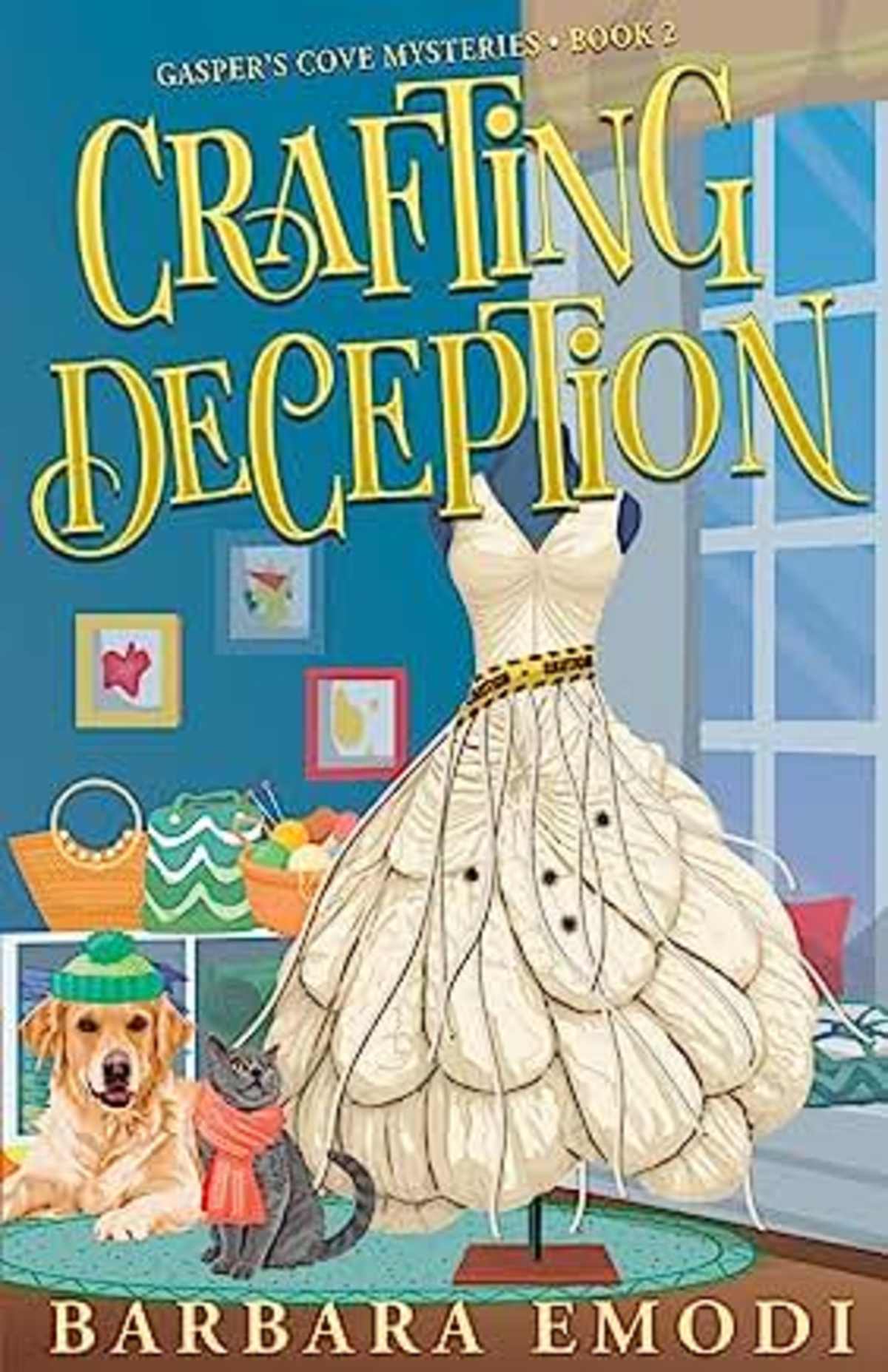
When a length of yellowed silk turns up in a bin at the Recreate and Recycle Depot, Valerie Rankin's sewing eye knows it is something special: a World War II parachute, the kind wartime brides once cut down into wedding dresses. But this one travelled a long way to a small town on the coast of Nova Scotia, and the story of how it got here reaches back to a secret buried aboard a gold ship in 1939. Crafting Deception is the second book in the Gasper's Cove Mysteries, a warm, funny Canadian cozy series about small-town crafters, the treasures hiding in plain sight, and the trouble that comes looking for them. Here are the Prologue and Chapter One to get you started.
PROLOGUE
Hms Emerald, September 1939
Ordinary Seamen Jones and Mowat stared down.
“This is the top-secret mission? Bars of soap?”
“Don’t be daft, mate. Don’t you know gold when you see it?”
“Gold? That’s the cargo going across the Atlantic to Canada. What for?”
“Where have you been? There’s a war on. Her Majesty’s government needs to buy arms from the Yanks.”
“Well, my lad, what’s the big plan? It was your idea to drop the crate to see what was in it. What do we do now? We can’t nick it.”
“True enough. They’ll count the bars for sure. But hang on, what’s this? There’s a pouch underneath, at the side. Almost missed it.”
“Come on, what do you see? What’s in it?”
“Not sure. Looks like some old rubbish jewelry to me, but if it wasn’t valuable, it wouldn’t be here. Get a move on, help me nail these boards back.”
“You’re keeping it?”
“Safekeeping’s more like it. I know just the spot we can stow it until we dock in Halifax. Some blokes there will buy anything. Might as well have something for our troubles,” Mowat said.
Jones smiled and picked up a hammer.
No one would ever know.
CHAPTER ONE
“How about this? Voodoo knife, gently used?” Annette’s flowered pen was poised above a card.
“You are a genius,” I said. “Do it. How else are we going to get rid of an old carving knife?” That settled, I reached into the bin of textiles, my specialty, and pulled out a cotton rectangle. “Now who would donate a tea towel with rust stains on it?” I asked the room.
Annette put down her pen and moved in for a closer look; as manager, she was in charge of quality control. “Hydrogen peroxide, that’s what you need. Those are old blood stains, but that will take them out. Trust me, I have boys.”
“How about we sell them together? The knife and the bloody tea towel. Make them a set?” Catherine suggested. For the town librarian, she was an unexpectedly inventive volunteer. It was her idea to attach quirky note cards to our hard-to-identify items before we put them out on the shelves of the Recreate and Recycle Depot.
“Sure. Can you do that, Darlene?” I asked my cousin and best friend. There was no response.
I waved my hand in front of Darlene’s unfocused eyes. “You okay?” I asked. Our shift was almost done, and then I was back to the Crafter’s Co-op. We had to keep moving.
Darlene shook her henna waves and met my eyes. “Sorry, I have a lot on my mind.”
“Like what?”
Darlene reached for a folding chair behind our communal worktable and sat down. “My mother is trying to kill me,” she said.
“What? Why would you even say that?” This made no sense. All the time I was growing up, I thought my aunt Colleen was the perfect mother. I’d wanted to live in her house instead of in the spotless order of mine, her home had a different project in every room—a glue gun plugged in on the kitchen counter, a pattern pinned to fabric on the ping-pong table in the basement, unconnected granny squares on the backseat of the car, and half-done mittens on the arm of the recliner. Colleen seemed incapable of not making things, but as I got older, it became clear to me that women like her did crafts precisely so they didn’t kill anyone. In her case, that would have been my uncle, a charming man who did “this and that,” and her seven reckless just-like-their-father boys. I was sure Colleen wasn’t out to murder her daughter, the only responsible member of the family besides herself.
Darlene stared up at the metal trusses in the ceiling of the building, here on the edge of Drummond’s industrial park, and sighed.
“It’s the move,” she said. “I’m down to my last nerve. Now that Dad’s gone, Mom can’t keep living alone at the end of that road. Coming into town is for her own good. But I swear, by the time we get that house cleared out, there will be nothing left of me.”
My phone buzzed in my pocket. I ignored it. This was more important.
It buzzed again.
“Can you be specific?” Catherine asked. “What’s the problem?”
Darlene swept her eyes around the jumbled mess of the Depot’s intake room as she struggled to explain. “The house is like this place, but worse. She saved everything.”
I picked up some lace yardage and pulled it straight along the measuring tape on the side of the table. Darlene’s mother taught me to sew when I was eight. I still used those skills in the sewing classes I taught. What could I say in her defense?
“Maybe your mom doesn’t want to see her whole life lined up in garbage bags along the road,” I suggested. “She was raised when it was a sin to waste anything. Tell her to donate. Look around here.”
Annette agreed with me. “Listen, that’s what we did with Mom’s jewelry collection. She sold Avon for forty years and owned every piece of jewelry they ever put out. We gave up trying to figure out what to do with it, so we took our pick and brought the rest in here. It just made sense.”
Darlene stared at the bins around us, filled to the top with remnants of fabric, beads, craft loom bands, faded embroidery transfers, tufts of wool roving, and abandoned quilt pieces.
“You don’t get it. Mom wants to dole it out. She’s obsessed. Do I want the plate the Girl Guides gave her when she was commissioner in 1967? Do I want the flannelette for the pajamas she cut out when I was six?” Darlene’s eyes went glassy with tears. Catherine pulled a neatly folded tissue out of the pocket of her jeans, the denim faded along the pressing marks down the legs, and handed it to her.
Darlene sniffed. “If I say no, I don’t want it, she says someone might, it’s still good, hangs up, and phones the boys. Then, my brothers call me to say make her stop bugging us. I can’t take much more of this.”
Catherine snorted in a very un-librarian-like way. “It’s always the daughter who gets stuck with the work,” she said, with the authority of someone who had been there herself. “Nothing causes trouble in a family like possessions. Two of my aunts are still not speaking because one of them sold my grandmother’s Singer Featherweight.” We considered this. Maybe the angry aunt had a point; those machines had a beautiful straight stitch.
“It’s so hard being the only girl,” Darlene continued, her hands twisting purple rickrack into a looped figure eight between her French manicured fingers. “The boys are useless. They only did the garage in case Granddad hid booze in there during his rum-running days, but that’s it.” Her voice rose with desperation. “Mom keeps saying, ‘I’ll make a pile.’ Do you know how many piles there are in that house? If we ever had to call the paramedics, all they’d find would be a little old lady buried under a thousand tiny balls of leftover yarn.”
“There’s your answer right there,” Catherine said. “You’ve just got to get through to her that what she gives away might be useful to someone.”
Catherine was right. “Good point,” I said. Why, just past the doors of this room, customers were waiting to buy donated sewing machines, checked by someone named Ralph, “working moderate, foot pedal not too bad,” bundles of old National Geographics, a fur stole with one mink eye missing, and matted wigs. No one should ever underestimate the creative consumer’s ability to see potential in just about anything.
Darlene was unconvinced. “I’ll talk to her, not that it will do much good.”
I started to argue but was interrupted when Annette tossed a loose cloud of fabric onto the middle of the worktable.
“Val, you’re the sewing teacher. What’s this? Silk?” Annette asked, spreading out a large thin sheet of yellowed fabric, tightly woven, with flat-felled seams along its length.
“Hang on,” I said, moving quickly across the room, a prospector spotting a gold nugget in a stream of polyester remnants. I reached out and rubbed an edge between my thumb and fingers. “I think you’re right. It’s silk.”
“It’s made into something. What is it?” Darlene asked. “A sail?”
Catherine raised her glasses from the chain around her neck and lifted a corner of the fabric to have a closer look. “No, it’s not a sail. Do you know what this is? It’s an old parachute from the war. The harness has been cut off, but look, it still has a few of the D rings.”
I stared at her. “Are you serious? A parachute? How do you know?”
“I’ve seen these in books,” Catherine said, letting her glasses fall onto her Liberty print blouse. “I’m sure that’s what it is, from World War II. The men brought the parachutes home, and the girls made wedding dresses from them. My mother’s sister was married in one. She used the same parachute that saved her fiancé’s life when he was shot down. They had to sew appliqués over the bullet holes.”
This was our heritage, resourceful women. “Just think, it was the only fabric they had to work with,” I said. “Kind of sad and happy at the same time. But how did something like that end up here, in a small town on the coast of Nova Scotia?”
Catherine shrugged. “Who knows? Bit of a mystery. But the point is, we can’t put this out to sell. It’s an artifact. I’ll take it,” she said, reaching for the fabric. “I’ll find out where we should send it. They’d know at the Archives in Halifax.”
“Hang on,” Darlene said, no longer interested in her mother’s move. “Do you think we’re looking at a tragic love story?” she whispered, laying a reverent hand on the fabric. “Maybe some bride saved this silk for a wedding dress she never made.” She bent down. “Look, there are numbers and a word stenciled on the hem at the bottom. It’s blurry, but I can still read it. ‘Fairy’ something. How sweet is that?”
“Very sweet,” I said, cutting Darlene off. My cousin’s three marriages had not ended well, but she remained a romantic, something I’d left behind a long time ago. I was more intrigued by the parachute’s strange arrival in this room. “If only objects could talk,” I said. “I wonder who dropped this off.”
“I can ask,” offered Annette. “We take donations every Tuesday. Next time she’s in, I’ll ask the lady who handles it if she knows anything.”
“Would you?” I said. “There’s a story there, and I’d love to know what it is.” My phone buzzed in my pocket again. Who was trying so hard to reach me?
I pulled out my phone and looked down. There were six texts from Rollie, another cousin, and manager of Rankin’s General, our family store over in Gasper’s Cove. Bad news. Found Waldo.
Waldo. That would be Wally Butt from “Wally’s Authentic Celtic Tours,” a man as famous for fabricating the facts he told tourists as for getting lost. The locals had nicknamed him “Where’s Waldo” Butt. But where had Rollie found Waldo? Good news. He brought friends.
Rollie meant customers. One of Wally’s tours had landed at the store. Bad news. They’re running around in the Co-op.
Rats. Rollie had no idea how to work the vintage cash register on the second floor. Need more hands on deck. Polly at school.
Not good. Thirteen-year-old Polly, the store’s unofficial helper, wouldn’t be there until the bus dropped her off at 3:30, and Donald “Duck” MacDonald, our ex-con handyman, was probably waiting out the tour’s visit down in the basement with Shadow, the store cat.
There was no need to listen to the voicemail. Rollie, a lovely man but no retailer, was alone with a liar on wheels and tourists rifling through our crafts.
I tapped back as quickly as I could.
Hang on.
Don’t let anything happen.
On our way.
I looked at all the donations still to be sorted, and then at Darlene. “Crisis across the causeway,” I whispered.
Darlene did a mental translation—she knew this meant time for a Rollie rescue. “Let’s hustle,” she said, grabbing her purse from behind a stack of jackets and following me out the door to the parking lot out front.
Once we were settled in the car and Darlene had snapped on her seatbelt, she looked over at me. “There’s a name for it, on the tip of my tongue,” she said.
Distracted, I flipped on my left turn signal, ready to turn onto the road that led over the water to Gasper’s Cove. Fifteen minutes tops and we’d be there. How much could happen in fifteen minutes?
“Name for what?”
“Like my aunt’s chair,” Darlene said.
Where did that come from? “Chair? Darlene, you have a lot of aunts, and they have a lot of chairs.”
“Frank’s wife, that aunt, you know, the fancy one in her entry? They found it on the beach, set up on the rocks like someone had been sitting there and got up and walked away,” Darlene persisted. “You know what I mean, don’t you? A thing that washes ashore, and they never know where it came from? What do they call it?”
“Not a clue,” I said, which was true.
Darlene held her bag tightly on her lap and stared out the window down at the water on either side of the short land bridge we called the causeway that connected the town of Drummond to our little community.
Her head snapped up. “Got it. I remember,” she said, pleased with herself.
I looked over.
“What is it?” I asked.
“Ghost gear,” Darlene said. “They call it ghost gear.”
Crafting Deception, Gasper's Cove Mysteries Book 2, is available in paperback and ebook wherever books are sold. Find it here.