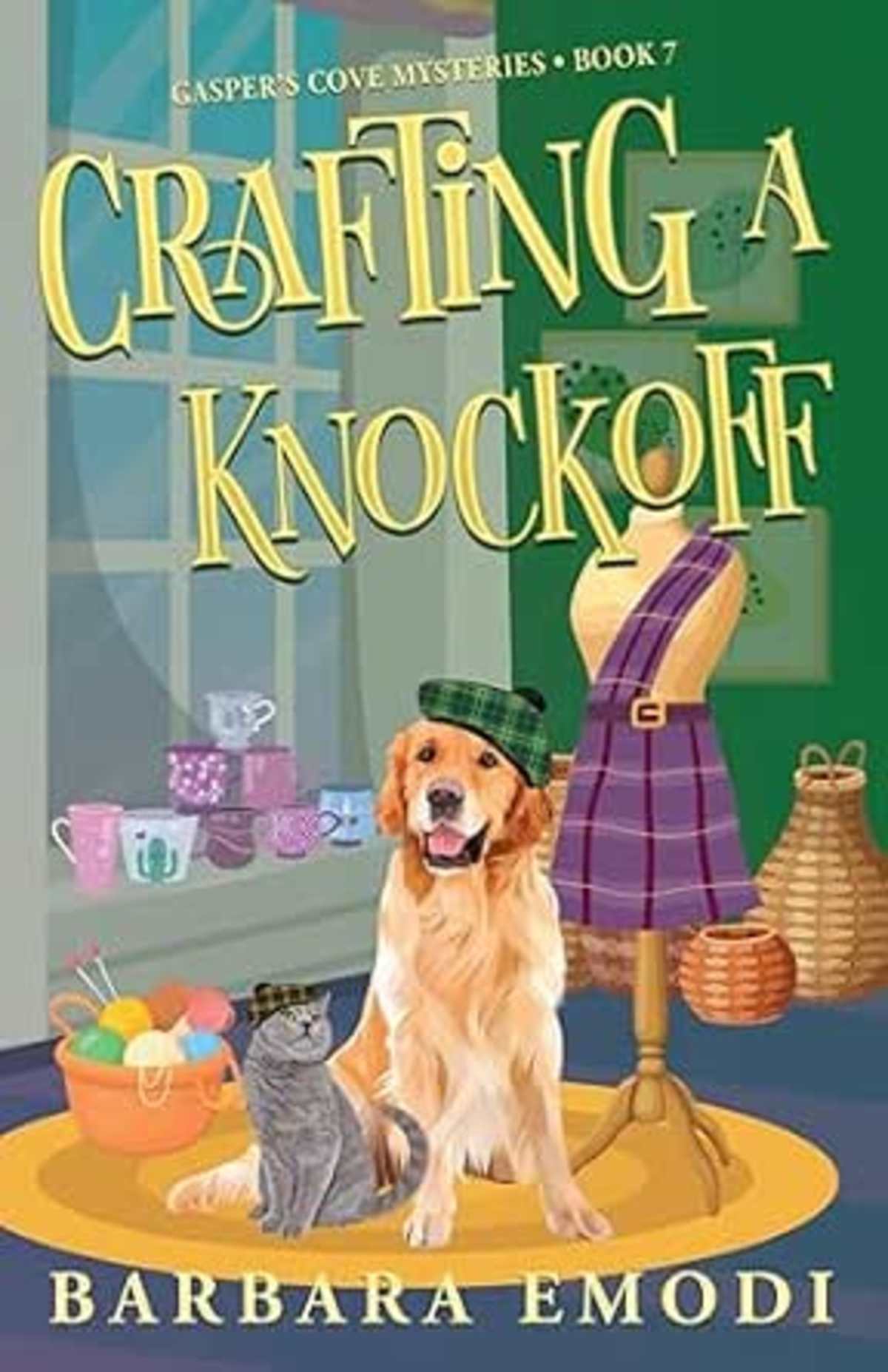
Craft shows can be dangerous. Valerie Rankin learns exactly how dangerous when the lights go out at the Thirteenth Annual Gasper's Cove Spring Craft Show and only a trolley piled with vintage quilts saves her from a nasty fall. Waiting on the other side of it is Louise Haggerty, a big-city "sustainable fashion" designer who has come to little Gasper's Cove hunting for local quilts and linens to upcycle, and who has her eye on Valerie's Crafters' Co-op. Never risk competition, she says, when you can choose collaboration. Valerie is not so sure. Crafting a Knock Off is the seventh book in the Gasper's Cove Mysteries, a warm, funny Canadian cozy series about small-town crafters, the value of handmade things, and the trouble that follows when outsiders come to cash in. Here is Chapter One to get you started.
CHAPTER ONE
Craft shows can be dangerous.
Deadly.
I should know.
The signs told me to stay safe at home.
Dark clouds pressed down on the street outside, promising nothing good. One shoe had disappeared overnight. While I looked for it, I spilled my coffee on the outfit I had made for this day, a silk jersey I couldn’t afford—dry clean only, now ruined. I changed into my backup, a rayon dress everyone had seen before, and that made me look matronly. Toby, my golden retriever rescue, positioned himself between me and the door. I tried to reassure him and reached for my keys on the little vestibule table where they rested between drives. Where had they gone? Run off with the shoe?
Oh, the warnings were there. Whispering to me like they sometimes did.
Did I pay attention?
Of course not.
How could I? This was the end of May, the last chance to sell winter-made crafts before the first full moon in June, the official start of the Nova Scotia gardening season, which would consume everyone’s weekends. The importance of the Thirteenth Annual Gasper’s Cove Spring Craft Show overrode any distractions or omens. My cousin Darlene would be at the booth in the arena now, waiting for me.
But how would I get there? Where were my keys?
I searched. First in logical places, like pockets, then in illogical ones, like behind the 40-year-old smocked cushions inherited with the house from my aunt. I even looked under the whisk and wooden spoons in a kitchen drawer. I gave up. In my experience, lost things were found when they were ready.
It couldn’t be rushed.
Until then, I had an emergency. I had one option left. I took it.
I called Stuart.
“Are you out and about?” I asked casually, as if I were passing the time. Stuart was a friend, and one I thought about more than I liked to admit. I didn’t want it to be too obvious that he was also evolving into my Mr. Reliable. “In the car, maybe?”
“I’m on my way to the yacht club for a meeting.” There was a pause while Stuart listened for what I hadn’t said. “You can’t find your car keys again.” This was a statement, not a question. “Where do you want to go?”
The yacht club was at one end of the island, the arena at the other.
“Nowhere,” I lied. “I’m fine.”
“The show. It’s today, isn’t it? Wait for me in front of the house. I’m turning around.”
Stuart hung up before I could say, “Don’t bother.” Or “Thank you.”
Gasper’s Cove arena hosted craft shows every spring and fall. In small Nova Scotian communities, hockey rinks are often used for any gathering too large for a living room or a church basement.
The arena was not a perfect venue. Cold and drafty, its disguise as an exhibition hall was questionable, but it was big enough to hold the throngs of shoppers, craftspeople, and retailers who poured in from the local area, the rest of the province, and even New England. For many artisans, sales from the shows were a major source of income. This mattered. Traditionally, forestry and fishing had dominated Nova Scotia’s economy. But recently, tourism, with its appetite for crafts, was catching up. The Gasper’s Cove Crafter’s Co-op had a booth at both the pre-Christmas show and this one, marking the end of winter. The spring event was my favorite. To me, the rows of tables displaying what creative people had made over the cold, dark months were as much a confirmation of the persistence of life as the spring tulips.
It didn’t take Stuart long to pick me up and get me to the rink. The old building was nestled like a giant weathered turtle at the end of Front Street, not far from our family store, Rankin’s General Store, on the side of the road away from the water, and near where the remnants of the town petered out. Stuart knew his way around the arena’s parking lot. He bypassed the big public doors out front and drove me straight up to the exhibiter’s entrance at the back of the building. He parked near the loading-dock doors, next to a diagonal row of panel vans, one with Sparky’s Electrical painted on its side.
“Looks like Jimmy’s working today,” Stuart said, noticing the truck. “I hope Sparky’s paying him overtime.”
“Don’t count on it,” I said, then regretted it. Sparky Bailey was the only electrical contractor in town. He ran his business with the combination of nonchalance and greed that monopolies tended to encourage. I suspected that Sparky paid his employees just enough to make them show up at work, and not much more. Jimmy MacNeil, Stuart’s favorite nephew, was Sparky’s best young electrician. I knew Stuart worried about Jimmy, his sister’s son. He didn’t need me to confirm that Jimmy could have done better than settle for a future with the local contractor.
Stuart sighed. “Jimmy needs to stand up for himself. I can’t do it for him.” He looked over at the box of pottery mugs on my lap. “Why don’t I give you a hand taking those in?”
I considered the offer, and Stuart. He had on his new windbreaker with “President” embroidered over the yacht club logo. His dark curly hair was still damp from the shower, and he had even tried to part it. I had diverted him on his way to his first meeting as the club’s new president. Stuart was never late for anything. He shouldn’t be late for this. Not because of me.
“No. You go.” I hoisted the load of mugs myself and got out of the car before Stuart could help me. “I’ve got Darlene in there. She’ll help me unpack.”
“I don’t know, Valerie,” Stuart said, doubtfully, “that box looks heavy.”
“Go. I’ll be fine.” I got out of the car and closed the door on his protests.
Stuart hesitated, then drove away, his tires crunching on the gravel, his eyes on me in the rearview mirror.
The box weighed more than I had admitted. I shifted it to one hip to free up a hand to pull open the metal door to the arena. The door, weary, dented, and battered by decades of hockey sticks and boys horsing around, protested. I noted a paper sign—“Authorized Exhibitors Only!”—taped over “Player’s Entrance.” I knew the arena would be hockeychilly inside, despite the flooring laid over the ice and the bunting and promotional banners draped over the rink’s boards to hide the penalty boxes.
Stepping through the doorway was like walking into a freezer. Inside, I adjusted my box, pushed my handbag farther up my shoulder, and moved across the landing to the steep concrete steps down to the center of the arena, where it would be warmer once the crowds showed up. Behind me, the door opened, then shut, with finality. Other exhibitors, with their own loads, lined up around me. First in line, and conscious of them, I moved forward to the stairwell.
I lifted my foot. It skidded on the wet tread of the first step.
I tried to shift my box again so I could grab the handrail.
But before I could find it, there was a loud crack overhead.
The lights went out.
I stopped still, my foot raised. The steps in front of me disappeared.
The box loosened in my arms. The weight of the pottery inside pulled me forward.
I wobbled.
Someone rushed down the stairs past me. Instead of offering the helping hand I expected, they shoved me into the wall. I caught the smell of mothballs and thought of wool. Distracted, I felt my balance go. My shoes slipped.
I fell, throwing my collection of hand-turned coffee mugs ahead of me. I heard them bounce down the stairs, smashing as they went, ricocheting down over the concrete steps. One last time, I tried to find the handrail. It had vanished. My fingers skidded over the painted blocks of the wall. Out of control, I covered my face with my arms, as I fell faster than I could think. Instinctively, I braced myself, closed my eyes tight, and waited for a messy end, smashed into the concrete floor of a converted ice rink.
Instead, I made a soft landing into a pile of …
Quilts.
The lights went on.
I was stretched out full length, belly down, surrounded by broken pottery, but safe. Unhurt. I lifted my head to get a better look at what had broken my fall. I had, by some miracle, by the intervention of some angel who knew how to sew, landed not on a hard, unwelcoming arena floor but onto a trolley stacked with quilts. The one under me I recognized immediately as a double wedding ring, handstitched and meticulously pieced. Reflexively, I smoothed the fabric. Judging by the wear and the small motifs of the fabric, it had been made in the 1950s or earlier, maybe in the 1940s. Some of the fabric in the borders looked like feed-sack cotton. The handiwork and intervention of other women in another time had saved me.
My world made sense again.
I sat up.
A firm grip helped me to my feet.
“My quilts!” A tall blond woman in a crazy quilt jacket inspected my landing place through turquoise framed glasses. “Good,” she muttered to herself, “no blood.” She flashed me a smile and flared her eyelash extensions. “And you? Are you alright?”
“Fine,” I said, looking at the shattered mugs on the concrete floor. “Better than my pottery. When the lights went out, I guess I tripped.”
The woman looked up into the arena’s rafters. She was annoyed but trying to be gracious, even though she didn’t have the time for it.
“The electrical system in this building is a disgrace. This is the third time this morning this has happened. A decent show brings in outside power. All we have here is some kid who doesn’t talk. But then again, where am I?”
“Gasper’s Cove, Nova Scotia?” I offered. It was my turn to be gracious. My mother had brought me up to be polite to strangers, even rude ones.
“Right. ‘Last Gasp’ they called it at the hotel over in Drummond.” She waited for me to laugh along with her. “That’s funny,” she explained.
I looked down at the wedding ring at my feet. The hand quilting was impeccable, every stitch regular, undoubtedly done years ago by a fisherman’s wife during long, lonely, worried evenings.
“Beautiful work,” I said. I felt it was time to talk about what locals did, not where we were. “Are you a collector? Here to sell?”
The woman held out her dolman-sleeved arms for inspection. She was thin under the colorful padded jacket and dressed all in black. She wore a turtleneck, a long narrow skirt, and high-heeled boots with toes so pointed, they would be useful for stepping on spiders in corners.
“Louise Haggerty,” she announced, as if her name explained everything. I searched my memory for information on any Haggertys I knew and came up blank. “The designer,” she elaborated. “Montreal. Toronto. New York. Palm Beach?”
So many cities? My first thought was that the Haggertys must be a big family, then I caught myself.
“Designer?” I asked. “You mean clothes? I sew too. I teach classes.” We had something in common. I’d work with that.
Louise lowered her arms, possibly in defeat.
“Sustainable fashion. We upcycle original textiles into unique pieces. No two are the same. I collect handembroidered linens and quilts.” She looked down at the trolley at her feet. “I let the pieces inspire me. I usually don’t do these shows myself.” She exhaled all her second thoughts. “But my marketing man suggested I come up here. I thought, why not? I am always looking for sources. Like the ones you fell on.”
Louise Haggerty had my attention. These quilts were from here? Who from? I wondered. Homes up and down the shore all had quilts like these. I’d be interested to know who was selling. I’d find that out. Not much got past my crafting network.
“Sorry,” I said, putting out my hand. “Valerie Rankin. I’m here with the Crafter’s Co-Op. We have a booth.”
“Ahh, I’ve heard of you,” Louise let her hand float over mine without touching it. “You manage that store, don’t you? Rankin’s General? You run a crafter’s thingy out of the second floor, am I right?”
“That’s me. If we make it, we sell it. Got a great bunch of knitters, carvers, quilters … ”
“Right,” Louise cut me off. “That’s why my guy must have you in his export-focused sights. He said as much. Murray Nunn. Wider markets are where the real money is. But speak to me before you sign anything.”
Sign what? What was this woman she talking about? I had just fallen down a flight of stairs in a hockey arena. I had broken some of my best merchandise. I was wearing my second-best outfit. Somewhere inside this arena, I had a cousin in a craft booth looking at her watch and wondering where I was. I had passed my capacity for excitement and new information somewhere down along the seventh or eighth step. I had real things to do.
“Great to meet you,” I said as politely as I could, while I moved toward the double doors into the exhibit hall. “I’ll be sure to drop by and see your clothes. I have a lot to set up. I’ve got to get to my booth.” Show staff had arrived and were sweeping up the shards of broken mugs.
Louise slapped her hands on the handle of the trolley and moved past me. She seemed determined to do her best to use it like a quilt-stacked battering ram to get through the crowd and closer to the door.
“Brilliant,” she said. “Let’s catch up when we can. Grab a coffee.” The other exhibitors parted to let her by. “Never risk competition when you can choose collaboration,” she tossed back.
I watched Louise disappear into the show.
That sounded to me like good advice.
Or maybe another warning.
I wasn’t sure which.
Crafting a Knock Off, Gasper's Cove Mysteries Book 7, is available in paperback and ebook wherever books are sold. Find it here.