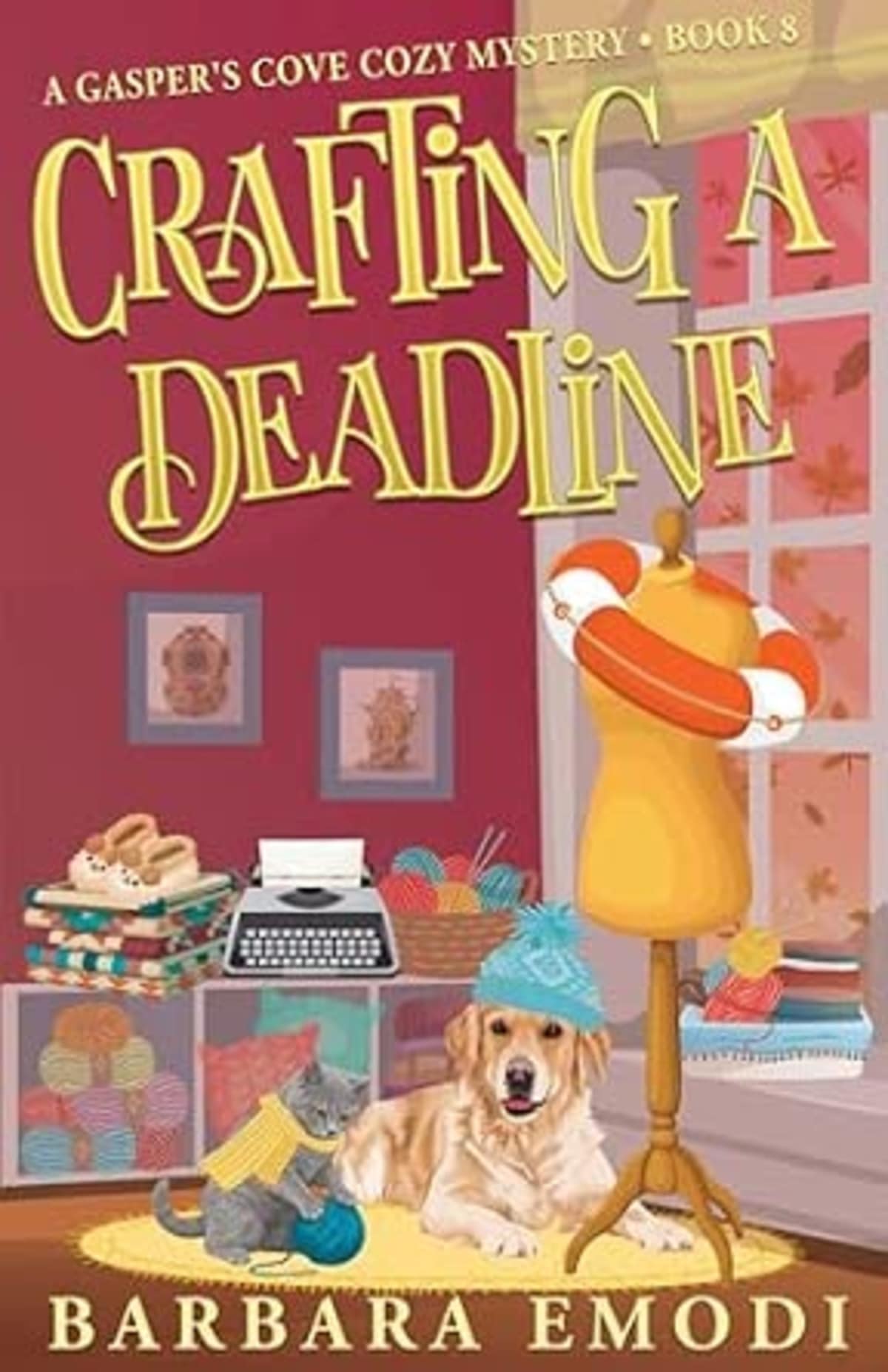
A federal deadline is bearing down on Gasper's Cove: restore the town's crumbling old lighthouse by year's end, or watch Ottawa replace it with a soulless LED tower. While the community argues it out on a storm-strewn beach, Stuart's daughter turns up something the tide was not supposed to give back, a message in a bottle dated 1962 that reads, "Being watched. Help not coming." The coordinates on it point to the exact spot where they are standing. Crafting a Deadline is the eighth book in the Gasper's Cove Mysteries, a warm, funny Canadian cozy series about small-town crafters, the history that washes ashore, and the trouble that comes with it. Here is Chapter One to get you started.
CHAPTER ONE
“Watch yourself!” Stuart’s strong, blue-gloved hand grabbed my arm. “Easy to slip and hurt yourself. Don’t get distracted.”
I caught the tightness in his voice. These days it seemed there was more on his mind, and on the tip of his tongue, than he was ready to share. But the town’s best engineer and I had kept company for a while, becoming what the community considered a couple. I was learning how to do that and be that, so I now understood that if I waited him out, eventually, Stuart would tell me what was bothering him.
But until then, we were together working on a beach, gathering up what the winter storms had thrown there. Who wouldn’t be distracted? The shore was full of surprises. It wasn’t litter we were collecting but remnants of stories sent by the ocean to be read. Some of them innocent. Some not.
Had this saltand sun-faded life preserver saved a life or failed? And what happened to the man with only one foam-soled shoe? Was he connected to the Cyrillic letters on the label of this jar? Or this pair of glasses. Who had worn them? And why was one lens shattered? Details of lives lived. Artifacts. Lost and not expecting to be found. All keeping their secrets to themselves.
Stuart watched my rubber boots find the flattest surface of an algae-draped rock and only then passed me a rusty corkscrew. I took it by the cork handle, the raft that had kept it afloat in the Gulf Stream it traveled to arrive here, maybe from thousands of miles away. I dropped the corkscrew into the collection bag, then bent down and pulled a frayed, faded length of lobster rope free from the rocks. It was braided with strands of seaweed, the float pods strung along it like beads. I shook it free of water and sand and observed the activity on the beach. Among the dozens of volunteers, students, and teachers, I picked out a couple in matching cargo pants, orange vests, and broad-brimmed hats. Heads down, they were diligently showing the high school students how to line up the bags of collected litter in the most precise row possible. This didn’t surprise me. Like his zoologist wife, Margaret-Ann, stockbroker Cyrus Winfield III was freckled, bespectacled, and relentlessly sincere. Walking past them, Duck, our store’s handyman, grinned. When he smiled, Duck’s mouth curled up on one side in a way that reminded me of Elvis Presley, but one whose handsome face had been weathered by life on the North Atlantic coast. As he approached, Duck pointed to the tangle of rope and seaweed in my hand.
“Better hide that quick, before Krista sees it.” He glanced at one of the crafters from the Co-op, her head deep in a litter bag. “You know what she’ll do with it.”
Stuart, stooping to snatch a Tim Hortons coffee cup from a swirl of ocean foam before it floated back out to sea, looked up. “What do you mean?”
I winked at our handyman. “Krista Willett? She makes wreaths out of beach debris—bits of netting, plastic rings from packs of beer cans, Styrofoam, and rope. Not our bestsellers. Tourists don’t like crafts that smell.”
“You got that right.” Duck hopped nimbly over the slimy rocks to stand next to us. He had crewed boats before a time in prison, which he had not deserved but had been a by-product of his birth into the MacDonald clan of crooks. All of this had made him a student of unusual behavior, having seen so much of it firsthand. “You know, Stu, she even tried to make wreaths out of old tires. Only sold the one—to the boys down at the garage.”
“She called them ‘postmodern door décor,’” I added. “Couldn’t give them away, not even at half price. Customers from away want Nova Scotian traditional—quilts, knitted hats, thrummed mittens, driftwood birds, sea glass suncatchers.” I looked at the old wooden lighthouse on the cliff above us. “And lighthouses, anything to do with them, sells like crazy.”
The sharp North Atlantic wind must have carried my words to a cluster of students and a few adults, some presumably teachers, close to us. The clatter of cans and debris tossed into bags stopped. One woman’s head snapped up.
“Did I hear ‘lighthouses’?” She teetered toward us. Unlike the locals, the newcomer was ready for a photo shoot, from the top of her stocking-capped head to the cuffs of purchased knitted socks carefully folded over the tops of shiny new boots. As someone who made all her own clothes, I recognized this as the kind of expensive outdoor readyto-wear that affluent urban folk ordered online and had shipped to their doors before they ventured out to locations as remote as ours. When she reached us, the woman nodded to Stuart with familiarity.
“The Peggy’s Cove lighthouse on the South Shore has nearly a million visitors a year,” she contributed to our conversation. “I took my 97-year-old mother there last year. She loved it.” This was no surprise. The lighthouse was a Nova Scotia icon.
“Everyone goes there but the locals,” a man in workingman’s steel-toed knee-high rubber boots and a flannel shirt muttered to the woman next to him.
The woman from elsewhere gave him a sharp look. “Do the math,” she snapped. “That’s the equivalent of a dollar for every citizen of this province. Not bad when you consider that there can’t be more than 40 people living in that community.”
I was struck by so much detailed information coming from someone tidying up a weather-battered beach, but then I saw the newcomer’s name tag: Dr. Clare Whitehead. She had pinned it precisely, parallel to the Canadian flag embroidered on her pill-free navy fleece jacket, right above Parks Canada, satin-stitched in yellow block letters.
The federal official waited until I had finished reading her chest before she introduced herself by extending a ringless hand.
“I know Stu, of course,” she shared, “but I don’t think we’ve met.” She glanced sideways at Duck, assessed him as attractive, but not in a way to interest a PhD, and continued. “Dr. Whitehead. I’m here on behalf of the federal government as a heritage assessment expert.”
Stuart looked away, apparently fascinated by two sea gulls fighting over the remains of a headless fish above choppy gray waves that would reclaim this beach as soon as the tide came back in.
“Valerie Rankin, manager of Rankin’s General Store here on the island,” I said as I closed my blue-gloved hand over the visitor’s and considered my other credentials. “Part-time sewing teacher, dog owner, first cousin of Darlene Kosoulas, the deputy mayor …” I hesitated and then threw in “… and a good friend of Stuart’s.”
When this got no reaction, I shifted to politeness. “Are you here to assess the stuff we find on the beach?”
Dr. Whitehead laughed, as if humor were a skill she had read about and was trying to learn. “No, no, no. My department received a grant request from your council to restore your lighthouse in response to the federal initiative to replace outdated lighthouses before the end of the year. That deadline is firm, by the way. I make the final recommendations, so I should know. And I do get that the urgency of this program puts communities like yours under pressure. So, I wasn’t surprised to see your council’s ask for a contribution from us for $75,000, and the promise that you would somehow match those funds yourself. But promises are not plans are they? Stu”—she tried to share a smile with him—“filed the engineering report submitted with the application from your municipality. I recognized his name and got in contact a few weeks ago. We have been talking ever since. It was his suggestion I come down and see the structure for myself before I made a call.”
Stuart, done with the sea gulls, gazed off down the beach to watch my golden retriever wrestle a stick from his own Nova Scotia Duck Toller. We were both aware that he had mentioned nothing of this project to me, and come to think of it, neither had my cousin Darlene, the famous deputy mayor. That shouldn’t have bothered me. After all, I wasn’t particularly interested in lighthouses. The idea of anyone living alone, with not one person to talk to and nothing to do but keep a giant light on, was unsettling, even worrying, to me. What kind of person, even in a necessary role, would want to live like that? It wasn’t normal; it wasn’t social; it wasn’t connected; it wasn’t … well, it wasn’t Gasper’s Cove. Perhaps my attitude was why nobody had told me about this plan.
Or was there another reason, something more personal?
I pushed that thought away, sure of only one thing: I would not let this well-coordinated woman even suspect that I didn’t know absolutely everything going on in my community.
“I guess you’re here to see if we can be another Peggy’s Cove,” I said, as if this were a fact I knew and not a question. “And what have you decided?”
Dr. Whitehead, the expert, shook her head and gave Stuart a discreet just-between-us-professionals eye roll. “You can’t compare what you have here to that lighthouse, which is a much more significant structure.”
We all looked up at our own disintegrating 30-foot octagonal wooden tower, with more weathered silver than white painted shingles. These days, it was neither substantial nor impressive. Built during the First World War, when no coast felt safe, it was now unmanned, abandoned by the last lighthouse keeper, who had left in 2014. Since then, it had housed only its single, original, rotating electrical light, left to guide seafarers home.
“We’re at a crossroads here,” Dr. Whitehead told the gathering crowd of debris collectors around her. “Either we replace the setup with a larger, freestanding, LED structure somewhere on the site and let the old building go.” A few of the onlookers whispered to each other. “Or we refurbish the historical building and upgrade the internal light.” Her eyes were on Stuart. “I’m no fool, you know. I appreciate that you folks have done your best to start repairing this building and that you had plans to do more. But time’s running out. Federal programs run on schedules and results, not intentions. Let’s say it out loud here. You are going to need money, ours from Ottawa and yours here, to make this happen, and whether or not you get those funds will depend on my judgment.” What did this mean? What was this woman trying to say?
Darlene would know. I searched for my cousin’s face and then saw her up on the road, near a dented RV, talking to her husband, George Kosoulas, as he loaded the nowempty coolers into the Agapi restaurant van. I waved to get Darlene’s attention. She saw me, left George, then skidded down the path between the tall beach grass to join us.
“Hello, Clare. What have you decided?” Darlene let her own bag of beach debris drop to the stones. Inside it, I saw a section of an old buoy, a sad collection of cigarette butts, plastic strapping, and what looked like a TV remote. This last find interested me. I often misplaced my own TV controller but had never dropped it in the ocean, or at least not that I was aware. I thought it was interesting that someone else had.
“About what?” Dr. Whitehead responded to Darlene’s question as if she didn’t know, tapping her watch, the kind with a tiny screen that didn’t require winding. “This beach cleanup? Very active.”
Stuart’s paternal pride brought him back into the discussion. “That’s because my daughter, Erin, is in charge of the school volunteers this time. She’s class president.”
“That’s lovely, Stuart.” Dr. Whitehead beamed a smile in his direction before turning it off when she faced Darlene. “But you mean the lighthouse, don’t you?”
Darlene straightened her posture, bringing her eye-to-eye with Dr. Whitehead. But before she could say anything, the man in the plaid shirt and boots pushed past her to face the heritage consultant.
“Bureaucrats,” he pronounced, then whipped his head around to glare at Darlene. “Politicians and”—he gestured to a balding man, new to me, in a municipal government windbreaker—“their lackeys,” he growled. “That building up there”—he gestured at the old lighthouse—“she’s had her day. It’s over. You got that?” Some of the adult volunteers moved in closer to listen. An argument between an Ottawa functionary and Patrick Cormier, formerly of the fishermen’s association, not a man to back away from a fight, and one who often started them to demonstrate that, would be entertaining.
“I guess you think I’m an old fella down here to help gather up whatever our boats have let wash in, but don’t let that fool you. I’m on to ya.” Patrick allowed his outrage to build up to show level. He moved in closer to us and shook an outsize, nicotine-stained finger, swollen with work, time, and arthritis, close to Dr. Whitehead’s face. “Matching funds, you call it? Don’t fool me. That’s Central Canadian code for ‘get a bunch of dumb locals to tax their own selves so you can all build another scenic destination for Air Canada ads.’ And where’s that tax money going to come from? Us. Most folks around here living fish catch to fish catch, paycheck to paycheck. If you figure we’re going to put up with this scheme, and you, you’re dead wrong.”
Behind Patrick, more rubber boots shifted on the sand and the rocks; some moved closer to him in agreement and support, while others drifted away. The lines split, I noticed, between families and friends, which, in this community, was unusual. Only the Winfields remained in the middle, neutral, but curious.
Catherine Walker, former librarian and current co-owner of a bed-and-breakfast with my cousin, Rollie, stepped out of the circle of watchers and into the middle of the disagreement.
“Abandon the lighthouse?” she asked, raising her voice with an over-my-dead-body certainty. “We’ll do what we have to do. We can’t let a century of Maritime history slip away. We need to save our own past.” A few of the mothers and grandmothers of students, busy helping with the cleanup, applauded.
The man in the Greater Drummond and Gasper’s Cove town windbreaker moved forward. The breeze lifted his comb-over vertically. The high schoolers in attendance tried to hide their giggles. “Bruce Bell. Newly appointed heritage and tourism officer, for the municipality,” he said, pleased to use the opportunity of the riveted crowd to introduce himself. “That’s it, isn’t it? Got to balance your cultural symbols and your tourism. There’s a solution somewheres. Will require expertise. That’s why you got me.” The crowd looked confused, raised their eyebrows, and looked away.
“Isn’t that Bruce from parking enforcement?” I whispered to Darlene.
“It is, but he pestered the mayor into a promotion,” she replied, lowering her voice so none of her constituents could hear. “He organized the ribbon cutting at the mackerel festival last spring. Told the mayor he was good with scissors. And he’s willing to continue to work for nothing.”
“Makes perfect sense,” I whispered back.
Next to me, Dr. Whitehead ignored the building conflict. Instead, she consulted the flat, dark screen of her watch, as if searching for her next appointment or messages from the modern world. “None of this is my concern,” she said, as if that fixed that. “My responsibility is to optimize community resource allocation. Whatever decision the federal government makes will be entirely data driven. Nothing else.”
“Data?” Patrick bellowed, pushing Bruce Bell aside, shouting more loudly than was necessary on a beach, but clearly energized by the nodding heads beside him. “You come to my kitchen table and show me and the wife how we’re going to eat data. And to the rest of you”— Patrick’s bushy red and gray eyebrows lowered as he glared at Catherine and the group with her, crafters from the Co-op and members of her book club—“you don’t live off history. Take it from someone who has seen the fisheries in decline for decades but kept at it, worked the most dangerous job in the country, I did. When my hip went out, I kept working, traffic control in the Causeway. Adapt. Deal with the life in front of you. What’s gone can’t be brought back.”
A sudden gust of wind that came out of nowhere broke the silence that followed this manifesto, as if the sea were taking a stand in this debate, although I sensed it was on its own side, and no one else’s. Catherine tried to respond to the old fisherman, but the sharp salty breeze snatched her words away, and we couldn’t hear them. A column of students, their trash bags abandoned, advanced. Then, from farther down the beach, Stuart’s daughter, Erin, ran toward us, her feet crunching on seaweed, popping the pods.
“Dad, Dad,” she shouted, the wind blowing her dark hair into the corners of her mouth. “You’re not going to believe what we found! A bottle with a message in it. We found it in the stones where the cliff is falling apart. Look!” Erin held the bottle up, thick, green glass bubbled and scarred, squat and wide-mouthed, like the ones my granddad used to drink his rum out of. In her other hand was a rolled paper, half letter-size, yellowed, and creased.
The crowd of adults parted, argument on hold, to let Erin get closer to her dad. As she came near us, I felt a twinge of recognition in my chest when I saw in her face the total faith of a child in a parent. Whatever Erin had to tell her father, she trusted he would know exactly what to do.
Stuart took the note from his daughter and, conscious of the faces watching him, but mostly of hers, unrolled it, took his new glasses out of the pocket of his shirt under his orange vest, and read out loud:
December 4, 1962
Being watched. Help not coming.
Daniel B.
44.64° N -63.33° W.
There was ice between my shoulder blades, like a cold finger running down my spine. I shivered and tried to shake it off. On the other side of the group, I saw Margaret-Ann Winfield, wife of the III, watching me. Stuart raised his face to his daughter. Her eyes were wide, expectant.
“How creepy is that? What do you think?” she asked, waiting to be told that it wasn’t creepy at all, that the message had a logical explanation. She fixed on the only objective piece of information. “Those numbers? Dad, what do they mean?”
Her father looked unsettled. This worried me.
“It’s sort of an address,” he explained carefully to his daughter. “Longitude and latitude, the coordinates for a place.”
“Really?” Erin asked. “Can it tell us where the note came from? Can we look it up?”
“No need to,” said Stuart, the weekend sailor. “I know it. It’s the exact location where we are now. Right here, on this point. Gasper’s Cove, Nova Scotia.”
Crafting a Deadline, Gasper's Cove Mysteries Book 8, releases in October 2026 and is available to preorder wherever books are sold. Preorder it here.